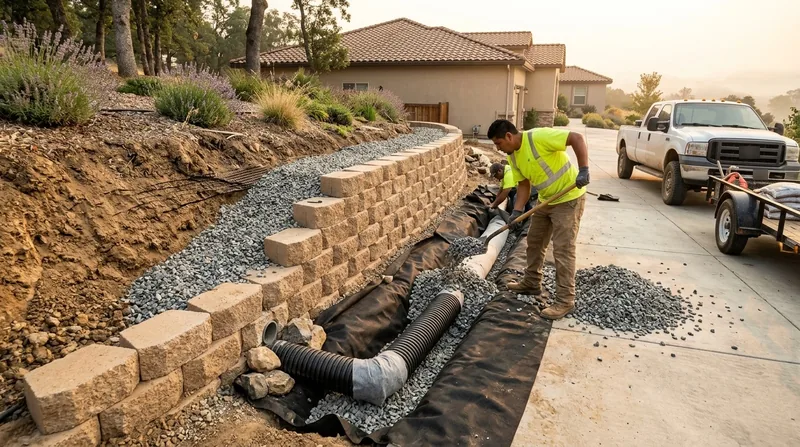




Retaining Wall Drainage in Sacramento
Sacramento sits on flat valley ground where the American and Sacramento rivers meet, ringed by levees, and that geography drives every drainage decision we make. In Land Park, Curtis Park and East Sacramento, 1920s to 40s bungalows sit on raised lots behind low concrete and brick garden walls that were never built with a drain behind them. Out in Natomas and the Pocket, newer tracts sit on low river ground with a high water table, so water pushes against the wall from below as much as from behind. East toward Folsom, Granite Bay and El Dorado Hills, cut-and-fill lots of decomposed granite shed water fast until it hits a wall face. If you need Retaining Wall Drainage in Sacramento, the fix is almost always the same: relieve the hydrostatic pressure before the wall bows, cracks or leans. We install French drains, weep holes, gravel backfill and waterproofing built for this valley's dense clay and hardpan. Start with our retaining wall repair page if your wall is already moving.
Why Drainage Decides Whether a Sacramento Wall Stands or Bows
Sacramento's clay and hardpan hold water like a bathtub after winter storms. When a wall has no drain, that water saturates the backfill, adds thousands of pounds of pressure, and finds the weakest seam. We see it every spring: bowing block walls in Carmichael, cracked brick garden walls in East Sacramento, and rotting 1970s railroad tie walls in Fair Oaks that soaked through for decades.
- Hydrostatic pressure is the number one cause of retaining wall failure on Sacramento clay, and a drain is the only real cure.
- Walls on raised lots in Land Park and Curtis Park often have no weep holes at all, so water exits through the mortar joints instead.
- Low river ground in Natomas and the Pocket needs a drain plus a water table check before we backfill.
- Foothill walls in Folsom and El Dorado Hills need surface water diverted before it reaches the wall face.
- Railroad tie walls in Fair Oaks and Carmichael rot from the inside out when water sits behind them.
Every drainage job we do starts with finding where the water actually goes, not just where it pools.
Key info: A block wall on a Curtis Park raised lot had no weep holes and a solid clay backfill. After two wet winters it leaned four inches. We rebuilt the backfill with drain rock, added a perforated footing drain and weep holes, and the wall has not moved since.
For the code side of wall height and permits, check the City of Sacramento Community Development building division before you build or rebuild.
How We Relieve Water Pressure Behind a Sacramento Wall
We work from the soil out, because a drain that does not move water away from the wall is just buried pipe. On Sacramento clay we open the trench, check the footing and the wall face, then build the drainage layer in the right order so water reaches the pipe and leaves the property. On foothill lots in Granite Bay and Rocklin we also cut a surface swale to keep runoff from stacking up behind the wall.
- We dig out the failed backfill and expose the wall face and footing so we can see the actual damage.
- We grade the trench to a positive fall toward the outlet, because flat pipe on valley clay clogs and freezes in place.
- We lay perforated drain pipe in washed drain rock and wrap it in filter fabric to keep fines out.
- We core weep holes through concrete and block walls at the low point, spaced to match the wall length.
- We waterproof the wall face and refill with free-draining gravel, not the original clay.
- We tie the outlet to a pop-up emitter, a dry well or a storm line so the water leaves the wall zone.
We finish by testing the system with a hose before we close the trench, so you see it working the same day.
Key info: A Natomas tract home had a segmental block wall on low river ground with a high water table. We added a footing drain, gravel backfill and a dry well in the side yard, and the wall stopped seeping at the base after the first storm. See the 95816 drainage page for the East Sacramento version of the same fix.
Drainage Approaches We Use on Sacramento Walls
Not every wall needs the same system. A low garden wall in Land Park and a tall terraced wall in El Dorado Hills fail differently, so we match the approach to the wall, the soil and the water source.
| Approach | Description | Best for |
|---|---|---|
| French drain behind the wall | Perforated pipe in washed gravel with filter fabric, graded to an outlet. | Clay lots in Land Park, Curtis Park and East Sacramento. |
| Weep holes and face waterproofing | Cored outlets at the low point plus a membrane on the wall face. | Concrete and brick garden walls with no existing outlets. |
| Gravel backfill replacement | We swap saturated clay for free-draining rock behind the wall. | Bowing block walls in Carmichael and Fair Oaks. |
| Surface swale and grading | We cut a graded channel to divert runoff before it reaches the wall. | Cut-and-fill lots in Folsom, Granite Bay and El Dorado Hills. |
| Dry well or pop-up outlet | We route drain discharge to a dry well or a pop-up emitter. | High water table ground in Natomas and the Pocket. |
We pick the combination that fits your wall and your lot, then we tell you why it fits before we start.
Retaining Wall Drainage Cost in Sacramento: What to Expect
Drainage work starts from $2,500 for a standard French drain and weep hole system on a residential wall. That figure covers a typical run with pipe, gravel, fabric, outlets and the labor to open and close the trench. Most Sacramento walls land in the $2,500 to $6,500 range once the backfill is replaced and a dry well is added.
What moves the number: wall length and height, how much saturated clay has to come out, access for a mini excavator in a tight Land Park side yard, and whether the wall is leaning badly enough to need leaning and collapsed wall repair at the same time. A high water table in Natomas adds a dry well. A foothill wall in Rocklin may need a swale cut above it.
Get two or three written estimates and compare scope, not just price. One bid may skip the filter fabric or the outlet, and that is where the savings disappear in two winters. Our full pricing overview breaks down the line items.
Retaining Wall Drainage Near Me: How to Choose a Contractor Near Sacramento
You want a contractor who has dug in this clay before and can tell you where the water goes before quoting a number. A wall on raised ground in Curtis Park and a wall on river ground in West Sacramento need different answers, and a good contractor will say so.
Check whether the work needs a permit. Many jurisdictions require one for walls above roughly 4 feet from the footing, or when the wall supports a driveway or structure, and engineered drawings may be required for tall or tiered walls. Confirm thresholds with the local building department. If you are in an HOA, get the drainage plan approved before trenching. Then call us at (916) 891-1319 or use the contact page for a free estimate.
Retaining Wall Drainage in Sacramento: Pricing Guide
| Service | Price | Details |
|---|---|---|
| French drain and weep hole system | Starting at $2,500 | Includes perforated pipe, gravel, fabric, weep holes and outlet for a typical residential wall run. |
| Gravel backfill replacement | Starting at $3,200 | We remove saturated clay and refill with free-draining rock, priced by wall length and depth. |
| Dry well or pop-up outlet addition | Starting at $900 | Routes drain discharge away from the wall, sized to your lot and water table. |
| Complex or large-scale drainage job | On estimate | Tiered walls, tight access or combined leaning wall repair need an on-site look first. |
| Travel | Included | In Sacramento and surrounding areas, no separate call-out or mileage fee. |
| Estimate | Free | Response within 24h at (916) 891-1319, no obligation to book. |
Indicative pricing, the exact cost depends on square footage, finish, and site access. Free personalized estimate within 24h at (916) 891-1319.


