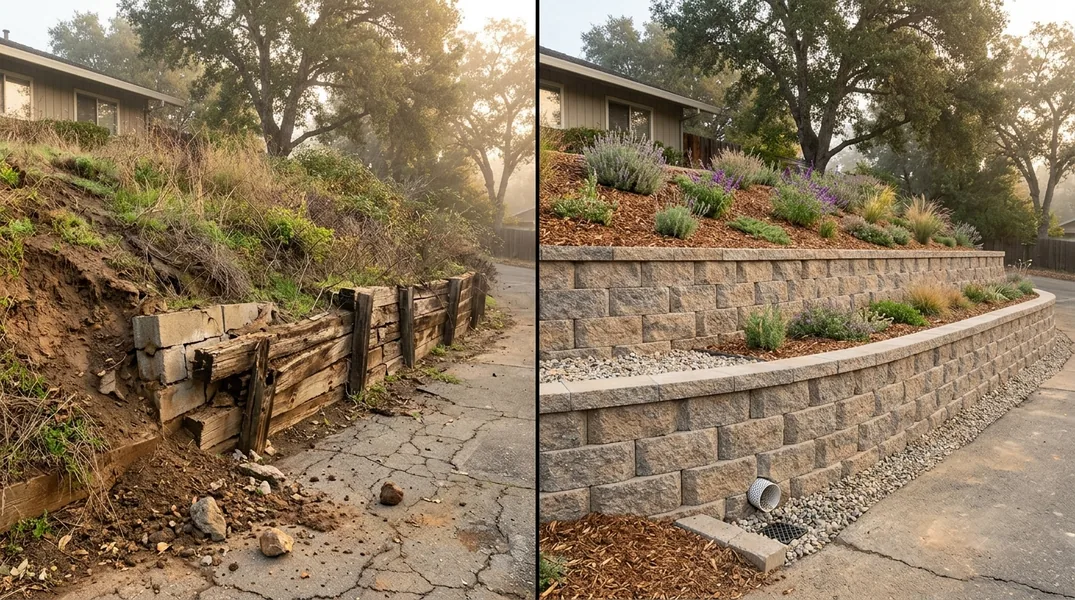
Why Sacramento's Soil Makes Material Choice Critical
If you live in Sacramento, you already know that our soil is not like the sandy loam or loose gravel found in many other parts of the country. Much of the region sits on expansive clay and hardpan, and lots in the foothills around Folsom and Elk Grove bring additional challenges like slope, rock, and drainage issues. Expansive clay swells when it gets wet and shrinks as it dries, which means it constantly pushes and pulls on anything built into it. Hardpan, a dense layer of compacted soil and gravel, can be extremely difficult to dig through and can affect how a wall is anchored.
Because of these conditions, the material you choose for a retaining wall is not just a cosmetic decision. It determines how well the wall will handle lateral pressure, how long it will last, and how much maintenance it will require over the years. A material that works beautifully in a dry climate with sandy soil may fail prematurely in Sacramento's clay. Understanding the strengths and weaknesses of each common option will help you ask the right questions and make a confident choice for your property.
Concrete Retaining Walls: Strength for Heavy Clay and Hardpan
Concrete Retaining Walls are one of the most durable options for Sacramento properties, especially where clay and hardpan create significant lateral pressure. Poured concrete walls are massive and rigid, which allows them to resist the constant swelling and shrinking of expansive soil better than lighter materials. They can be engineered to handle taller heights and heavier loads, making them a smart choice for foothill lots with steep grades or for walls that need to hold back a large volume of soil. A properly reinforced concrete wall, installed with adequate drainage, can last for decades with minimal upkeep.
One thing to keep in mind is that concrete walls require careful site preparation. In hardpan, excavation can be slow and may require specialized equipment, and the wall's footing must be designed for the specific soil conditions on your lot. Cracking is also a consideration, so control joints and steel reinforcement are important. When these details are handled correctly by an experienced installer, concrete offers excellent value for homeowners who want a long-term solution. If you are comparing materials for a challenging site, it is worth discussing whether a poured wall fits your budget and goals.
Block Retaining Walls and Segmental Systems for a Clean, Flexible Look
Block retaining walls, also called segmental retaining walls, are built from interlocking concrete blocks that stack without mortar. These systems are engineered to flex slightly, which can be an advantage in clay soils that move with the seasons. Segmental blocks are available in a wide range of colors, textures, and sizes, so they can mimic natural stone or create a crisp modern look. Many segmental systems are designed with built-in setbacks and geogrid reinforcement, allowing them to handle taller heights while remaining stable. For homeowners who want a finished, uniform appearance and predictable performance, block walls are a popular choice across the region, including neighborhoods in Roseville.
The key to a successful block wall in Sacramento is proper base preparation and drainage. Because the blocks rely on a compacted gravel base and good water management, the installer must excavate to the right depth and account for the clay's poor drainage. Without a reliable drainage system, water can build up behind the wall and cause movement or staining. When installed correctly, a segmental retaining wall offers a great balance of durability, aesthetics, and reasonable cost. It is also easier to repair or modify than a poured concrete wall if sections ever need attention.
Boulder Retaining Walls: Natural Character for Foothill Lots
Boulder retaining walls use large, natural rocks to hold back soil, and they are especially well suited to foothill properties where a rustic, organic look fits the landscape. On sloped lots with existing rock or uneven terrain, boulders can often be integrated with the natural surroundings more gracefully than manufactured materials. They are also excellent for erosion control and can be installed with wider gaps that allow water to pass through, which helps reduce hydrostatic pressure. For homeowners who want a wall that looks like it belongs on the site, boulder walls are an attractive option.
However, boulder walls are not right for every situation. They generally work best at lower heights, and their stability depends heavily on proper placement, embedment, and the weight of the stones. In soft clay, a boulder wall may settle or shift if the base is not prepared correctly, and the irregular surface can make it difficult to attach fences or other structures. Boulder walls also require access for heavy equipment, which can be a challenge on tight lots. A professional assessment can tell you whether boulders are a practical fit for your slope, soil, and access conditions.
Retaining Wall Installation Near Me: Matching Material to Your Site
There is no single best material for every property in Sacramento. The right choice depends on your soil conditions, the height and purpose of the wall, the slope of your lot, your budget, and the look you want. A short garden wall holding back a small planting bed may be perfectly served by segmental blocks, while a tall wall on a foothill lot with heavy clay may call for engineered concrete. Boulder walls can be ideal for naturalized settings but may not suit a formal landscape or a tight urban lot. A qualified installer will evaluate drainage, soil, and access before recommending a material, rather than pushing whatever is easiest to install.
If you are unsure where to start, a professional site evaluation is the most reliable way to avoid costly mistakes. The team at Sacramento Retaining Wall can assess your property, explain how each material performs in local soil, and provide a clear plan. Whether you need new construction or are considering Retaining Wall Repair for an existing wall that is leaning or cracking, getting expert input early can save you time and money. Call (916) 891-1319 to discuss your project or request a free estimate.
Retaining Wall Installation Cost in Sacramento: What to Budget
Homeowners often ask what a retaining wall will cost, and the honest answer is that pricing varies significantly based on the material, wall height, length, soil conditions, and site access. A short block wall on flat ground with easy equipment access will cost far less than a tall engineered concrete wall on a steep foothill lot where hardpan must be excavated. Boulder walls can be cost-effective for lower heights but may require expensive equipment if access is limited. Drainage work, permits, and engineering fees can also affect the total. Because every property is different, a site-specific estimate is the only way to get an accurate number.
It also helps to think about long-term value rather than just the initial price. A wall that is undersized or poorly drained may need expensive repairs within a few years, while a properly designed wall can last for decades. Investing in the right material and correct installation upfront usually costs less than fixing a failed wall later. If you are planning a new wall or need Retaining Wall Replacement, reach out for a detailed assessment and a transparent estimate so you can budget with confidence.
Looking for a professional retaining wall contractor in Sacramento? Sacramento Retaining Wall responds fast for all your retaining wall needs.
Get a Free QuoteOur services: Retaining Wall Installation · Retaining Wall Repair · Retaining Wall Replacement